
HONOR. COURAGE. COMMITMENT
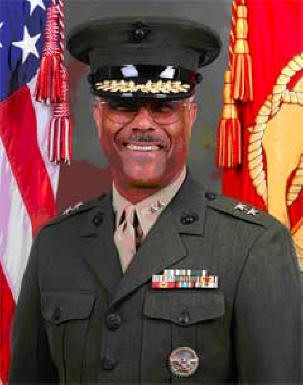
These values define the U.S. Naval Academy, its midshipmen and its alumni. Major General Leo V. Williams III ’70, USMCR (Ret.), integrates these values into every aspect of his life and relying on them, has built a legacy of leadership and service, blazing trails of inclusion and making new paths for future leaders to trust.
That legacy started more than 100 years ago on the banks of The Chesapeake Bay in Norfolk, VA.
“My grandfather, Leo V. Williams Sr., joined the Navy when he was only 14, in 1903, as a cabin boy,” Williams said. “When he was old enough to enlist, he did. That was in 1907 as a steward. In that time, the only jobs that were available to Black people in the Navy were steward, cook or fireman.
“He retired, for the second time, in 1941, after 38 years of service. My father enlisted in the Navy in 1944, eventually becoming one of the first Black medical corpsmen in the Navy.”
This family tradition of service to country and breaking barriers was foundational to Williams, who took the lessons and trials of his father and grandfather and used them to tread new paths at the Naval Academy, the Marine Corps and the corporate world at Ford Motor Company. Even in retirement, Williams continues to serve the Academy, the Medal of Honor Leadership and Education Center and his home Charleston, SC, community with the same passion and skill that has defined his life.
He points to his family, his community and the Academy for forging the values of integrity and truthfulness that have shaped his path.
“I appreciated those lessons more and more as I grew up. It was something I wanted to see and ensure that my sons and their children saw and learned from. I strove to show integrity and truthfulness with my associates so that I could teach the lessons when I could. These lessons were amplified by the Academy experience.”
Williams is highly accomplished in his military and civilian life, breaking racial and culture barriers in every realm. He credits his home, community and school life for the inspiration, encouragement and persistence to achieve.
“In 1963, my father graduated from the University of Virginia with a master’s degree in education, the first Black student to receive that degree,” Williams said. “He then became the principal of an all-Black elementary school. Ironically, it was named Robert E. Lee Elementary in Norfolk.
“When Norfolk began integrating schools, he became the first Black principal of a predominantly white elementary school."
” Williams had great examples from an early age of what it meant to be a path breaker. Graduating in 1966 from Norfolk’s all-Black Booker T. Washington High School, he was the class valedictorian of a class of 550 students. When it came time to make his own post high-school decision, military service was high on the priority list.
He chose to continue his family’s legacy of military service but with a slightly different path.
“When you grow up in Norfolk, the Navy presence is strong,” Williams said. “Some are good examples but every Marine you see stands out. One of my best friends in high school’s older brother set a pattern for me. He was a Dartmouth graduate and chose to go into the Marine Corps Reserve after graduating. He was one of the first Black Marine Corps pilots. Tragically, he died in a training accident.
“That sacrifice made a great impression on me. He set a poignant example for me. It’s a choice I’ve never regretted.”
There was another benefit for Williams.
“And everybody knows the Marine Corps has the best-looking uniforms in the world,” he said, with a smile.
PERSEVERANCE REWARDED
Williams accepted the challenge to attend the Naval Academy to pursue his dream of becoming a Marine Corps officer. But the path to admission was filled with barriers. The most challenging was securing a nomination from a member of Congress. In the Jim Crow South, there was an unwritten agreement among members of the House and Senate from former Confederate States to deny nominations to any Black students.
But the tightknit Norfolk community where Williams was raised knew his potential and understood the importance of the opportunity.
“My homeroom teacher found out that one of my best friends and I wanted to apply to the Academy. Her father in Detroit had a connection to Representative Charles Diggs” Williams said. “She connected her father to the congressman, and he connected to us. In the end, Congressman Charles Diggs from Michigan nominated both my best friend and me from Virginia. We were admitted to the Class of 1970 and became the first Black students from Virginia to attend the Naval Academy.”
The Class of 1970 started out with only 12 Black students out of a class of 1,200. By the time they graduated, only six remained out of 850, less than 1 percent of the student body.
“Throughout my four years at the Academy, I was almost always the only Black midshipman in any of my classes,” Williams said. “Only once did I have another Black student in a course with me. That condition became a benefit for me because there was no choice for me, but to really understand the people I dealt with every day.
“That setting became a course in and of itself. You have to teach yourself how to make it through. An outgrowth of the situation was the Black support team we formed among ourselves. The other Black midshipmen, faculty and staff all had a hand in providing support for us.”
His commitment, drive and skill were noticed by others.
“As a midshipman, Leo had very mature and practical leadership traits that enabled him to navigate and excel in an environment that was not as welcoming to him as it was to the other 4,000 midshipmen,” wrote Admiral Robert Natter ’67, USN (Ret.), in Williams’ DGA nomination. “It was obvious by his actions that Leo was determined not only to survive the Naval Academy but that he was determined to learn, thrive and lead. His leadership even then was an example to all who knew him.”
Being part of such a rare community during the Academy experience was pivotal to Williams’ future.
“When you graduate and become a United States Marine, the people you work for and work with and who work for you are a kaleidoscope,” Williams said. “The present Academy level of diversity invites a real understanding of diversity, equity and inclusion. The Black students in my time at the Academy didn’t fully appreciate that lesson until later when you look at the success we enjoyed in our careers.”
The experiences Williams had as a midshipman were built on the lessons he learned from his parents, his community, his church and his schools. He learned how to excel, persevere, overcome challenges and to extend opportunities to those who came after him.
“We were conscious about maintaining a support group year after year so incoming Black midshipmen could have the best chance possible to succeed,” Williams said. “The support group became a literal lifeline because most folks who didn’t look like us did not know how to help us, except to do what they always did. We had to figure it out ourselves with one or two Black faculty members. They were very supportive. We knew they were always there when we needed them.”
After graduating from the Academy, Williams was commissioned as an officer in the Marine Corps, where he served for eight years as an infantry and artillery officer, a rare combination of combat arms specialties. In 1978, he left active duty and transitioned to the Marine Corps Reserve, where he continued his career for another 25 years, attaining the rank of Major General and deploying two times in support of Operation Desert Shield/Desert Storm and the War on Terrorism.
BARRIER BREAKER
His military career was side by side with his work as an executive at Ford Motor Company, where Williams continued to break barriers. Most often, he was the only Black executive in his division. During his career with Ford, Williams mastered strategic planning, new vehicle development and brand management for the Ford F-150 pickup truck and all of Ford’s SUVs.
He and his team were charged with naming new SUVs at the time. Williams took this unique opportunity to have Ford Motor Company give a salute to the expeditionary “Go Anywhere, Do Anything” character of the Marine Corps. Voila; the Ford Expedition was launched.
In retirement, his service to the Academy has continued and even grown. He has served as the first Black director on the U.S. Naval Academy Foundation Board and the first Black vice chairman of the USNA Alumni Association. He is currently helping to lead the development of the National Medal of Honor Leadership and Education Center in Mount Pleasant, SC, creating not only a physical space to celebrate the values that mark heroes but developing an entire education program of leadership and character development.
“Leo has demonstrated the most uncommon of virtues, accentuated by his humility and selflessness,” wrote W. Thomas McQueeny, chairman of the National Medal of Honor Leadership and Education Center. “These qualities have entailed the betterment of those within his sphere, as well as the amelioration of American society.”
Throughout his military and civilian career, Williams opened doors for others, in the same way his community supported him.
“In high school, I knew that my teachers and counselors wanted only the best for me,” he said. “Unless you have that kind of support, especially in a community that is underserved, you have a hand tied behind your back. When you have the sense that you can make a difference, it makes it easy to say, ‘Hey, let me look around and see how I can give others the same opportunity that I had.”
His commitment to leadership, his drive to develop a better future for the world and his embodiment of the values of honor, courage and commitment began in his home and community in Norfolk and were cemented in his time at the Academy.
“I want the Academy to be the best leadership school in America,” Williams said. “You can learn engineering anywhere; you can learn any of the majors at any university. None of those experiences is unique except the leadership lessons that you learn on a daily basis, every day you’re here. We need to hold tight to that goal and become the best leadership institution in the world.”
With distinguished alumni like Williams, that goal will become reality.
Updated: December 25, 2025
Curator: Ed Moore